Mobility Journey
Study Across Europe. Learn from Diverse Ecosystems.
BIOVERTE is more than a Master’s programme. It is an international learning journey through three distinct European regions, each offering unique environmental challenges, ecosystems, research perspectives, and cultural experiences.
As a BIOVERTE student, you will live, study, and learn in Lithuania, Italy, and Poland, gaining first-hand experience of how biodiversity conservation, ecosystem restoration, and environmental governance are addressed across Europe.
Why Mobility Matters
Environmental challenges do not stop at national borders.
Biodiversity loss, climate change, ecosystem degradation, and restoration efforts require professionals who can work across different ecological, cultural, and policy contexts.
BIOVERTE’s mobility pathway allows students to:
- Experience diverse European ecosystems
- Learn from different scientific traditions and environmental practices
- Build international networks
- Develop intercultural competencies
- Understand environmental governance from local to European levels
- Gain a truly European perspective on sustainability and resilience
Your BIOVERTE Journey
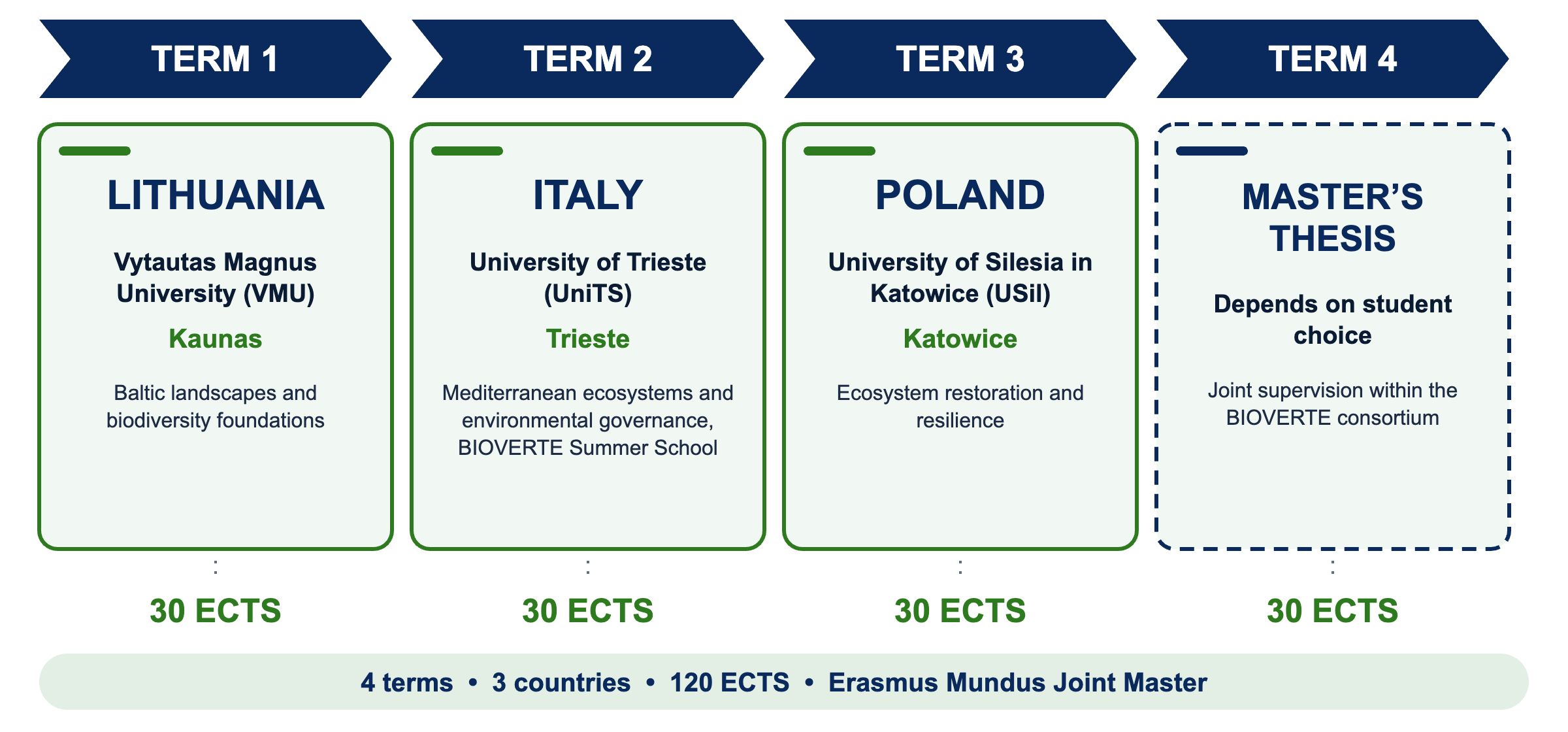
Semester 1
🇱🇹 Lithuania
Vytautas Magnus University
Baltic Landscapes and Biodiversity Foundations
Your journey begins in Lithuania, where you develop a strong foundation in biodiversity science, ecology, environmental policy, and ecosystem functioning.
Explore:
- Baltic forests
- Wetlands
- Rivers and freshwater ecosystems
- Agricultural landscapes
- Protected natural areas
What you’ll gain
- Understanding of ecological processes
- Biodiversity assessment skills
- Foundations of environmental governance
- Knowledge of European environmental challenges
Theme: Understanding Ecosystems
🇱🇹 Baltic Region
Freshwater, forests and wetlands
Learn how biodiversity conservation and ecosystem management support environmental resilience in northern Europe.
Semester 2
🇮🇹 Italy
University of Trieste
Mediterranean Ecosystems and Environmental Governance
In Italy, you move to one of Europe’s most dynamic environmental regions, where marine biodiversity, coastal management, and sustainability transitions are key challenges.
Explore:
- Mediterranean coastal ecosystems
- Marine protected areas
- Transitional wetlands
- Alpine environments
- Urban and coastal sustainability initiatives
What you’ll gain
- Environmental economics
- GIS and remote sensing
- Environmental modelling
- Sustainability governance
- Policy analysis
Theme: Managing Environmental Change
🇮🇹 Mediterranean Region
Marine and coastal ecosystems
Understand governance challenges, climate adaptation, and ecosystem management in one of Europe’s most climate-sensitive regions.
Summer School
Learning in the Field
The BIOVERTE Summer School brings together students and lecturers from all partner universities for an intensive field-based learning experience.
Working in mixed international teams, students apply knowledge gained during the first year to real environmental challenges.
Activities include:
- Ecological monitoring
- Habitat assessment
- Biodiversity surveys
- Environmental data collection
- Stakeholder engagement
- Applied group projects
Learn by doing
The Summer School is designed to connect science, practice, and policy through immersive field experiences and collaborative problem solving.
Semester 3
🇵🇱 Poland
University of Silesia in Katowice
Ecosystem Restoration and Resilience
Your final mobility semester takes place in Upper Silesia, a region recognised internationally for its unique post-industrial ecosystems and environmental transformation.
Explore:
- Restored mining areas
- Novel ecosystems
- Urban biodiversity
- Post-industrial landscapes
- Nature-based solutions
What you’ll gain
- Restoration ecology
- Biomonitoring
- Environmental remediation
- Ecosystem resilience assessment
- Nature-based restoration strategies
Theme: Building Resilient Futures
🇵🇱 Central European Post-Industrial Region
Novel ecosystems and restoration landscapes
Explore how biodiversity and nature-based solutions contribute to environmental transformation and ecosystem recovery.
Semester 4
Master’s Thesis
The final semester is dedicated to your Master’s thesis.
Working with supervisors from BIOVERTE partner universities and external experts, you will conduct independent research addressing contemporary challenges in:
- Biodiversity conservation
- Ecosystem restoration
- Climate adaptation
- Environmental governance
- Ecological monitoring
- Sustainable resource management
Beyond the Classroom
Mobility at BIOVERTE is about more than changing universities.
Students become part of an international community through:
- Joint field courses
- Summer schools
- Student projects
- Research activities
- Cultural events
- Professional networking opportunities
- Collaboration with environmental organisations and stakeholders
Each mobility period offers opportunities to engage with local communities, environmental practitioners, researchers, and policymakers.
A Truly European Experience
BIOVERTE’s mobility pathway is designed to provide more than academic knowledge.
By studying across Lithuania, Italy, and Poland, students develop the adaptability, intercultural awareness, and international perspective needed to address the environmental challenges of the future.
Discover new ecosystems.
Experience different cultures.
Build international networks.
Become a European environmental professional.
Three countries. One journey. Unlimited perspectives.